


Out of the plains of Wyoming rises Devil’s Tower. It is really a rock, visible for a hundred miles around, an immense cone of basalt which seems to touch the clouds.
Devil’s Tower sticks out of the flat prairie as if someone had pushed it up from underground.
Of course, Devil’s Tower is a white man’s name. We have no devil in our beliefs and got along well all these many centuries without him. You people invented the devil and, as far as I am concerned, you can keep him.
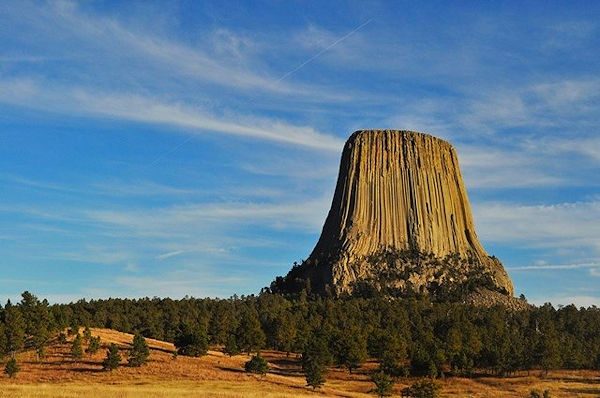
Picture of Devil’s Tower,
Photo courtesy of NPS.gov
But everybody these days knows that towering rock by this name, so Devil’s Tower it is. No use telling you it’s Indian name.
Most tribes call it Bear Rock. There is a reason for that–if you see it, you will notice on it’s sheer sides many, many streaks and gashes running straight up and down, like scratches made by giant claws.
Well, long, long ago, two young Indian boys found themselves lost in the prairie. You know how it is. They had played shinny ball and whacked it a few hundred yards out of the village. And then they had shot their bows still farther out into the sagebrush.
And then they had heard a small animal make a noise and had gone to investigate. They had come to a stream with many colorful pebbles and followed that for a while.
They had come to a hill and wanted to see what was on the other side. On the other side they saw a herd of antelope and, of course, had to track them for a while.
When they got hungry and thought it was time to go home, the two boys found that they didn’t know where they were.
They started off in the direction where they thought their village was, but only got farther and farther away from it. At last they curled up beneath a tree and went to sleep.
They got up the next morning and walked some more, still headed the wrong way. They ate some wild berries and dug up wild turnips, found some chokecherries, and drank water from streams.
For three days they walked toward the west. They were footsore, but they survived.
Oh how they wished that their parents, or aunts and uncles, or elder brothers and sisters would find them. But nobody did.
On the fourth day the boys suddenly had a feeling that they were being followed. They looked around and in the distance saw Mato, the bear.
This was no ordinary bear, but a giant grizzly so huge that the boys would make only a small mouthful for him, but he had smelled the boys and wanted that mouthful.
Mato kept coming close, and the earth trembled as he gathered speed. The boys started running, looking for a place to hide, but here was no such place and the grizzly was much, much faster than they.
They stumbled, and the bear was almost upon them. They could see his red, wide-open jaws full of enormous, wicked teeth. They could smell his hot evil breath.
The boys were old enough to have learned to pray, and they called upon Wakan Tanka, the Creator: “Tunkashila, Grandfather, have pity, save us.”
All at once the earth shook and began to rise. The boys rose with it. Out of the earth came a cone of rock going up, up up until it more than a thousand feet high. And the boys were on top of it.
Mato the bear was disappointed to see his meal disappearing into the clouds. Have I said he was a giant bear?
This grizzly was so huge that he could almost reach to the top of the rock when he stood on his hind legs. Almost, but not quite. His claws were as large as a tipi’s lodge poles.
Frantically Mato dug his claws into the side of the rock, trying to get up, trying to eat those boys. As he did so, he made big scratches in the sides of the towering rock.
He tried every spot, every side. He scratched up the rock all around, but it was no use. They boys watched him wearing himself out, getting tired, giving up. They finally saw him going away, a huge, growling, grunting mountain of fun disappearing over the horizon.
The boys were saved. Or were they? How were they to get down? They were humans, not birds who could fly.
Some ten years ago, mountain climbers tried to conquer Devil’s Tower. They had ropes, and iron hooks called pitons to nail themselves to the rock face, and they managed to get up.
But they couldn’t get down. They were marooned on that giant basalt cone, and had to be taken off in a helicopter.
In the long-ago days the Indians had no helicopters. So how did the two boys get down?
The legend does not tell us, but we can be sure that the Great Spirit didn’t save those boys only to let them perish of hunger and thirst on the top of the rock.
Well, Wanblee, the eagle, has always been a friend to our people. So it must have been the eagle that let the boys grab hold of him and carried them safely back to their village.
Or do you know another way?