


QUESTION:
I have three pieces of pottery I want to give to the Cahokian Indians. I’ve been told they are authhentic, and I bought them at a local flea market . I have not had them authenticated , but the person I bought them from said he dug them himself. If they are, I do want them to go to the proper people not just a collector or someone that just wants to resell them for profit. Although I did pay for them.I was wondering if you might know of someone in my area that may be able to take them off my hands from a tribe near me. Or a way for me to contact the proper representatives to take them to.
~Submitted by Steven L
The Cahokian indians are all extinct and have been for hundreds of years. First, I’m not a pottery expert, and I have not seen the pots, but from what you have told me, I am very sceptical that the pots are likely to be what they were represented to be. Here are some of the reasons I doubt their authenticiy.

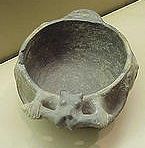
Above:Example of Cahokia era pottery
Below: Example of modern reproduction of Cahokia style pottery
1) You bought the pots at a flea market from a stranger and not from a known archaeologist, an expert pottery dealer, or museum. A flea market wouldn’t be my first thought for the best place to sell something like that if it was obtained in a legitimate archaeological dig. But then, if they came from a legitimate dig with the proper permits, I doubt they would be for sale at all, and I’ll explain why below.
2) They didn’t have a Certificate of Authenticity that came with them documenting a paper trail detailing in great detail the permits that authorized their excavation, and when and how and where they were aquired.
3) You didn’t mention what you paid for them, but I didn’t get the impression it was a huge price. If they really are that old, they would be very valuable. In fact, if they are really from Cahokian mounds, they are priceless artifacts. If you didn’t pay a small fortune, my guess would be they are either fakes made in Mexico or the dealer dug them illegally and really had no idea what they were worth.
4) Since you only have the seller’s word that he dug them up somewhere and no specific location was identified, I would be inclined to think it was only a line he gave you to get you to buy them. There are as many flea market vendors that are unscruptulous characters as there are honest ones, especially if they aren’t regular sellers that are there every week. Telling people that things are old is a favorite ploy unscruptulous flea market dealers use to induce a sale.
The Cahokian Mounds are located in the Mississipi river valley regions of southwestern Illinois. The Cahokia Indians are believed to have lived at Cahokia Mounds (also known as Monk’s Mounds), the largest mounds still remaining, and at least 120 other identified mound locations from 700 A.D. until about 1300, when their civilization began a rapid decline, and their civilization completely disappeared by 1500.
CAHOKIA MOUNDS is located just outside of Collinsville, Illinois, a short distance off Interstates 55/70 and 255, along Route 40 in a State Historical Park, which is land held in trust for the public.
Archeologists believe the Cahokian Moundbuilders’ decendants were the Natchez Indians, who were already in severe decline by the time the first Colonial explorers reached the Mississippi in 1673. Soon afterward, the Nachez Indians were completely wiped out by the French during a series of Indian wars along the river, so the Cahokian civilization has been extinct for about 500 to 600 years, AND their more modern decendants have been extinct for at least 300 years.
If he did indeed “dig them up,” that is a federal crime since most of the Cahokian Mounds I am aware of are burial sites and protected under the Native American Graves Protection and Repatriation Act. Even if they didn’t come from a burial site, the Archaeological Resources Protection Act of 1979 makes it a felony crime for excavating, removing, damaging, altering, or defacing any archaeological resource more than 100 years of age, on public or Indian lands, unless authorized by a permit. It also prohibits the sale, purchase, exchange, transportation, receipt, or offering of any archaeological resource.
There are a whole slew of other laws that make digging up cultural artifacts, transporting them, buying or selling them a serious crime.
In the External links section below, you will find links to the full text of the major Federal laws, regulations, standards and guidelines, and executive orders related to cultural resources management. The complete Federal Historic Preservation Laws book is available through the National Park Service. Federal Historic Preservation Case Law, 1966-2000, is available through the Advisory Council on Historic Preservation.
Related links on this site:
Cahokia Mounds mark Illinois’ most ancient city
While the record of European explorers in Illinois begins with the arrival of Marquette and Joliet in 1673, the chronicle of the Native American inhabitants dates back much further. This far earlier story, still only partially disclosed, reaches back into a dim and mysterious past. Scattered across the region are the relics of a dead and vanished civilization. They have been called the Mound Builders, thanks to the vast monuments of earth which tell of their previous existence…. an existence which is still shrouded in mystery.
Cahokia, Illinois was once home to a vast Indian civilization
Imagine for a moment that you are paddling up the Mississippi River near present-day St. Louis — about 600 years ago. In the distance you notice a huge, flat-topped earthen mound. Stairs on its front face lead up to an impressive lodge with a sharply peaked roof.As you near this landmark, you see that it dominates a city surrounded by a wooden palisade. Inside are numerous earthen mounds, thatch-roofed houses with pole walls, farm plots, a market, a spacious central plaza and about 15,000 people. This place, which we now call Cahokia, Ill., once covered more than five square miles of Mississippi bottomland.
Discovery in Wisconsin stirs scientific debate: Did two different cultures meet?
Before A.D. 1000, researchers are fairly confident about who lived in Wisconsin: It was the Late Woodland culture. After A.D. 1000, this culture vanished. In 1200, a new one, called Oneota, took its place. What happened between the disappearance of the first group and the arrival of the second remains a hotly debated subject. What is known about this period is that an impressively complex and thriving community was built in what is now Illinois, just across the river from St. Louis. There, a city called Cahokia came to life. A thriving metropolis, this city at its heyday was home to nearly 25,000 people.
External links:
Cahokia Mounds State Historic Site
This website can probably tell you who to contact to see if what you have is really the real deal or not, and if they are, what to do with them.
Abreviations used below: PL is for Public Law, Stat. is for Statute, USC is the U.S. Code, and CFR is the Code of Federal Regulations.
Native American Laws
Antiquities Act of 1906 as amended (PL 59-209; 34 Stat. 225; 16 USC 431-433) is the earliest and most basic legislation for protecting cultural resources on Federal lands. It provides misdemeanor-level criminal penalties to control unauthorized uses. Appropriate scientific uses may be authorized through permits, and materials removed under a permit must be permanently preserved in a public museum. The 1906 Act is broader in scope than the 1979 Archaeological Resources Protection Act, which partially supersedes it. Uniform regulations at 43CFR Part 3 implement the Act.
American Indian Religious Freedom Act of 1978 as amended (PL 95-431; 92 Stat. 469; 42 USC 1996) resolves that it shall be the policy of the United States to protect and preserve for the American Indian, Eskimo, Aleut, and Native Hawaiian the inherent right of freedom to believe, express, and exercise their traditional religions, including access to religious sites, use and possession of sacred objects, and freedom to worship through ceremonial and traditional rites. Federal agencies are directed to evaluate their policies and procedures to determine if changes are needed to protect such rights and freedoms from agency practices. The act is a specific expression of First Amendment guarantees of religious freedom. It is not implemented by regulations.
Archeological and Historic Preservation Act of 1974 amended the Reservoir Salvage Act of 1960 (PL 86-523; 74 Stat. 220, 221; 16 USC 469; PL 93-291; 88 Stat. 174; 16 USC 469) provides for the preservation of historical and archaeological data that might otherwise be lost as the result of Federal construction projects or Federally-licensed or assisted programs. The act provides that up to one percent of congressionally authorized funds for a project may be spent from appropriated project funds to recover, preserve, and protect archaeological and historical data.
Archaeological Resources Protection Act of 1979 as amended (PL 96-95; 93 Stat. 721; 16 USC 47Oaa et seq.) has felony-level penalties for excavating, removing, damaging, altering, or defacing any archaeological resource more than 100 years of age, on public or Indian lands, unless authorized by a permit. It prohibits the sale, purchase, exchange, transportation, receipt, or offering of any archaeological resource obtained in violation of any regulation or permit under the act or under any Federal, State, or local law. The Act’s definitions, permit requirements, and criminal and civil penalties augment the Antiquities Act, which it partially supersedes. It is implemented by uniform regulations and Interior-specific regulations, both at 43 CFR Part 7.
Historic Sites Act of 1935 as amended (PL 74-292; 49 Stat. 666; 16 USC 461) declares national policy to identify and preserve nationally significant “historic sites, buildings, objects and antiquities.” It authorizes the National Historic Landmarks program and provides the foundation for the National Register of Historic Places authorized in the National Historic Preservation Act of 1966. Regulations implementing the National Historic Landmarks Program are at 36 CFR Part 65.
National Environmental Policy Act of 1969, as amended (42 USC 4321, and 4331 – 4335) states it is the Federal government’s continuing responsibility to use all practicable means to preserve important historic, cultural, and natural aspects of our national heritage. It also instructs Federal agencies to prepare environmental impact statements for each major Federal action having an effect on the environment.
National Historic Preservation Act of 1966 as amended (PL 89-665; 80 Stat. 915; 16 USC 470), creates the National Register of Historic Places and extends protection to historic places of State and local as well as national significance. It establishes the Advisory Council on Historic Preservation, State Historic Preservation Officers, Tribal Preservation Officers, and a preservation grants-in-aid program. Section 106 directs Federal agencies to take into account effects of their actions (“undertakings”) on properties in or eligible for the National Register, and Section 110(a) sets inventory, nomination, protection, and preservation responsibilities for Federally-owned cultural properties. Section 110(c) requires each Federal agency to designate a Preservation Officer to coordinate activities under the act. Section 106 of the act is implemented by regulations of the Advisory Council on Historic Preservation, 36 CFR Part 800. The Department of the Interior criteria and procedures for evaluating a property’s eligibility for inclusion in the National Register are at 36 CFR Part 60.
Native American Graves Protection and Repatriation Act of 1990, as amended (PL 101-601; 104 Stat. 3048; 25 USC 3001 et esq.) establishes rights of Indian tribes and Native Hawaiian organizations to claim ownership of certain cultural items,including human remains, funerary objects, sacred objects, and objects of cultural patrimony, held or controlled by Federal agencies and museums that receive Federal funds. It requires agencies and museums to identify holdings of such remains and objects, and to work with appropriate Native Americans toward their repatriation. Permits for the excavation and/or removal of cultural items protected by the act require Native American consultation, as do discoveries of cultural items made during Federal land use activities. The Secretary of the Interior’s implementing regulations are at 43 CFR Part 10.
National Wildlife Refuge System Improvement Act of 1997 outlines gerneral management goals for the Refuge system including protection and interpretation of cultural resources.
Reservoir Salvage Act of 1960, as amended (16 USC 469-469c) extended the Historic Sites Act of 1935. It gave the Department of the Interior, through the National Park Service, major responsibility for preservation of archaeological data that might be lost specifically through dam construction.
1970 UNESCO Convention on the Means of Prohibiting and Preventing the Illicit Import, Export, and Transfer of Ownership of Cultural Property (19 USC 2601)
Regulations
Curation of Federally-Owned and Administered Archeological Collections (36 CFR Part 79)
Determinations of Eligibility for Inclusion in the National Register (36 CFR Part 63)
National Register of Historic Places (36 CFR Part 60)
Native American Graves Protection and Repatriation Act: Final Rule
(43 CFR Part 10)
Preservation of American Antiquities (43 CFR Part 3)
Procedures for State, Tribal, and Local Government Historic Preservation Programs (36 CFR Part 61)
Protection of Archeological Resources (43 CFR Part 7)
STANDARDS
Guidelines for Federal Agency Responsibilities,
Under Section 110 of the National Historic Preservation Act
The Secretary of the Interior’s Standards
and Guidelines for Archeology and Historic Preservation [As
amended and annotated by the National Park Service]
The Secretary of the Interior’s Standards
for Architectural and Engineering Documentation The Secretary of
the Interior’s Professional Qualification Standards (48 FR
22716, Sept. 1983)
The Secretary of the Interior’s Standards
for Rehabilitation (36 CFR 67)
The Secretary of the Interior’s Standards
for the Treatment of Historic Properties (36 CFR 68)
The Secretary of the Interior’s Standards
for the Treatment of Historic Properties with Guidelines for Preserving,
Rehabilitating, Restoring, and Reconstructing Historic Buildings
EXECUTIVE ORDERS
Consultation and Coordination with Indian Tribal Governments
(2000), Executive Order 13175
Preserve America (2003), Executive Order 13287, directs Federal
agencies to improve their management of historic properties and
to foster heritage tourism in partnership with local communities.
Protection and Enhancement of the Cultural Environment(1971), Executive Order No. 11593, directs Federal agencies to inventory cultural properties under their jurisdiction, to nominate to the National Register all Federally-owned properties that meet the criteria, to use due caution until the inventory and nomination processes are completed, and also to assure that Federal plans and programs contribute to preservation and enhancement of non-Federal properties. Some of the provisions of the Executive Order were turned into Section 110 of the National Historic Preservation Act.