| apache indians |
Apache Indians
Apache indian religion, food, clothing, weapons, homes and culture.
 The Apache Nation of tribes are further divided into divisions called bands and clans. There are five Apache reservations. Famous Apache chiefs and medicine men include Geronimo, Cochise, Juh, Nahche, Nakaidoklini, Victorio, Loco, Bonito and Mangas Coloradas. The Apache Nation of tribes are further divided into divisions called bands and clans. There are five Apache reservations. Famous Apache chiefs and medicine men include Geronimo, Cochise, Juh, Nahche, Nakaidoklini, Victorio, Loco, Bonito and Mangas Coloradas.
The word Apache probably comes from "įpachu," the Zuńi name for the Navajo, which means "enemy," or possibly Awa'tehe, the Ute name for Apaches, which means "People of the Mountains." They were called "Apaches de Nabaju" by the early Spaniards in New Mexico. The Apache are the most southerly group of the Athapascan language family. They are thought to have lived in the Southwest US for 1,000 to 1,500 years.
There are many Apache tribes and bands. Some Apache tribes are commonly called by synonomous names which refer to the same group of people. The name has also been applied to some unrelated Yuman tribes, such as the Apache Mohave (Yavapai) and Apache Yuma. The Apache call themselves N'de, Dinė, Tinde, or Inde, which all mean "the people."
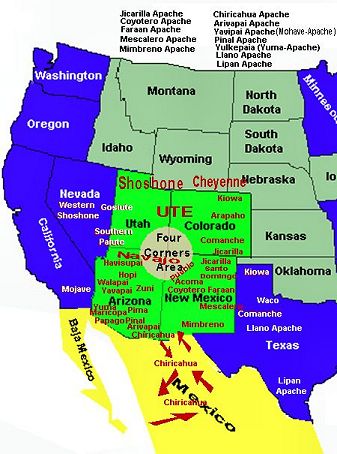
There are thirteen different Apache tribes in the United States today: five in Arizona, five in New Mexico, and three in Oklahoma.
They were first mentioned as Apaches by Ońate in 1598, although Coronado, in 1541, met the Querechos (the Vaqueros of Benavides, and probably the Jicarillas and Mescaleros of modern times) on the plains of east New Mexico and west Texas. There is no evidence that the Apache reached Arizona until after the middle of the 16th century.
Most Apaches were nomadic and lived almost completely off the buffalo. Some Apache tribes had a long history in what is now Texas. Western Apaches living near the Pueblo Indians became farmers. They once planted and grew maize, beans, pumpkins, and watermelons, but the Comanches would attack them in their fields and they were eventually forced to move westward further into New Mexico and Arizona.They used dogs as beasts of burden, and were the first Indians, after the Pueblos, to aquire and use horses.
The Yavapai and Apache were the last Indians to be subdued in the Southwest. Geronimo battled both Mexican and United States troops and became notorious for his daring exploits, raids, and numerous escapes from the military. In the end, 38 men, women and children evaded 5,000 U.S. Army troops and the Mexican authorities for twelve months. Geronimo's warriors became the last major force of independent Indians who refused to acknowledge the United States Government. This ended September 4, 1886, when Geronimo surrendered to the United States Army.
After the Chiricahuas surrendered in 1886, roughly 512 Chiricahuas, almost the entire population of all their bands, were shuffled from prison sites in Florida to Alabama to Oklahoma as prisoners of war for twenty-seven years. In 1912 they were finally allowed to settle on the Mescalero Apache Reservation in New Mexico but did not arrive until the following year.
In 1900 the members of the Apache tribe in the United States were classified as Coyotera, Jicarilla, Mescalero, San Carlos, Tonto, and White Mountain Apaches, and were located in Arizona, New Mexico, and Oklahoma. Today they have the Ft. Sill Reservation in Oklahoma, Jicarilla Apache Reservation and Mescalero Reservation in New Mexico, and the San Carlos and White Mountain Reservations in Arizona.
 | | San Carlos Apache Flag |
APACHE INDIAN TRIBES
FEDERALLY RECOGNIZED TRIBES
STATE RECOGNIZED TRIBES
(Not recognized by the Federal Government)
UNRECOGNIZED TRIBES
(Petitions Pending)
UNCLASSIFIED TRIBES
|
| | |
|
| | |
|
|
|
|
|
|
|
|
|
|
|
|
|
|
| | |
Apache Tribes Profiles |
|
|
|
|
|
|
|
|
|
|
|
| | |
Apache Reservations |
| | |
Apache Official Websites |
|
|
|
|
|
|
| | |
|
| | |
 |
|
|