


Native American sacred places are where Native Peoples who practice their traditional religions go to pray for the good day, the precious earth, the blessing waters, the sweet air and peaceful life for all living beings the world over.
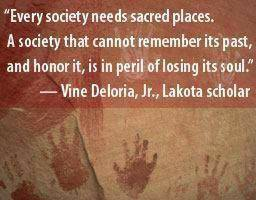 Native American religions were outlawed under the federal “Civilization Regulations” from the 1880s to the 1930s. Traditional Native Peoples were not allowed to go to or pray at their sacred places. All of the traditional religions were driven underground, some to the point of extinction.
Myriad Native American sacred places have been destroyed.
Today, far too many sacred places are being desecrated or threatened by development, pollution, poisons, recreation, looting, vandalism and by federal or federally authorized undertakings.
The American Indian Religious Freedom Act of 1978 was intended to change the policy of the United States from one of outlawing and disrespecting traditional Native religions to one of protecting and respecting them. The Act states:
“That henceforth it shall be the policy of the United States to protect and preserve for American Indians their inherent right of freedom to believe, express, and exercise the traditional religions of the American Indian, Eskimo, Aleut, and Native Hawaiians, including but not limited to access to sites, use and possession of sacred objects, and the freedom to worship through ceremonials and traditional rites.”
There are numerous existing laws intended to protect Native American sacred places and even more that can be used to do so, but most of these laws are being ignored and flaunted.
Among these existing legal authorities are the American Indian Religious Freedom Act, Native American Graves Protection and Repatriation Act, Executive Order on Indian Sacred Sites, National Historic Preservation Act, Archaeological Resources Protection Act, National Environmental Protection Act and other environmental and cultural laws.
There are no existing legal protections for certain categories of sacred places and none that provide a specific cause of action to defend sacred places against desecration or destruction.
Native Americans often are pressured to define the sacred when we talk about our religious freedom and protection of sacred places. No other religious leaders or practitioners are pressured to define the sacred in their religions or to identify what is central or indispensable to their beliefs and ceremonies.
Native Americans are pressured to reveal the details of our exercise of religious freedom, when no other religious leaders or practitioners are forced or required or urged or even asked to reveal details.
Many Native traditional religious matters cannot be discussed or revealed. Some Native traditional religious matters must remain private and confidential because disclosure would violate the tenets of the religions themselves. Other Native traditional religious matters must remain private because many Native leaders and practitioners still fear that such disclosures would lead to another federal Indian “civilization” era.
It has been the experience of Native Americans that disclosure about the location, nature or use of sacred places leads to assaults on them. Many of these places are fragile and have been destroyed by too many visitors or vehicles or activities.
The following description of Native American sacred lands is taken from the President’s Report to Congress on American Indian Religious Freedom, August 1979, pursuant to the American Indian Religious Freedom Act, P.L. 95-341:
“Those who are unprepared or whose behavior or condition may alter the ceremony are often not permitted to attend. The proper spiritual atmosphere must be observed. Structures may need to be built for the ceremony or its preparation.”
“The Native peoples of this country believe that certain areas of land are holy. These lands may be sacred, for example, because of religious events which occurred there, because they contain specific natural products, because they are the dwelling place or embodiment of spiritual beings, because they surround or contain burial grounds or because they are sites conducive to communicating with spiritual beings.
“There are specific religious beliefs regarding each sacred site, which form the basis for religious laws governing the site. These laws may prescribe, for example, when and for what purposes the site may or must be visited, what ceremonies or rituals may or must take place at the site, what manner of conduct must or must not be observed at the site, who may or may not go to the site and the consequences to the individual, group, clan or tribe if the laws are not observed.”
“The ceremonies may also require preparatory rituals, purification rites or stages of preparation. Both active participants and observers may need to be readied. Natural substances may need to be gathered.”
“The ceremony itself may be brief or it may last for days. The number of participants may range from one individual to a large group.”
SOURCE:
Prepared for the Coalition to Protect Native American Sacred Places
by Suzan Shown Harjo of The Morning Star Institute
611 Pennsylvania Ave., SE #377
Washington, DC 20003
Ph.(202) 547-5531
Ms. Harjo is a columnist for Indian Country Today.