


While the symbols used and their meanings varied from tribe to tribe, there were some common Indian symbols used on the war horse.
Each power symbol has its own specific meaning and the purpose for which it was used was determined by the nature of the dangerous job which the war horse would be asked to do. In this article, you will find explanations of some symbols which Indians used to decorate their war horses.
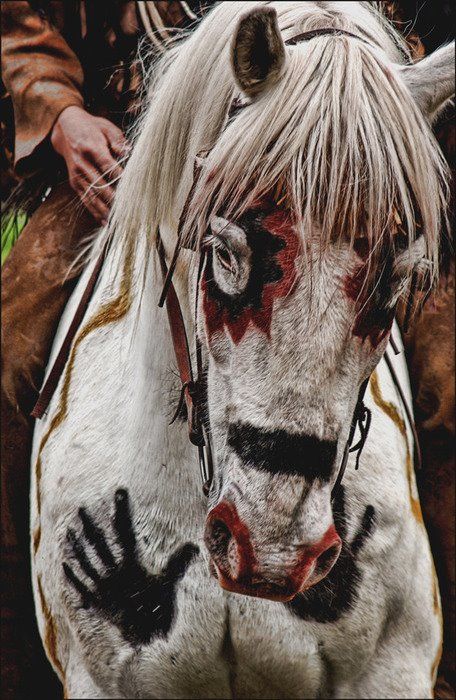 The Indian would decorate his horse with carefully chosen war symbols or power symbols which might be intended to give him protection, to indicate the troubles which lay ahead, or which spoke of the courageous heart of the war horse. Some symbols told of the horse’s affection for the warrior.
When the Indian groomed his horse for battle, he would knot up the horse’s tail to prevent the enemy from taking hold of it and using it to dismount him from his horse.
He would gather the mane into clusters, tying it to prevent entanglement in his bow and arrow during the combat.
 A circle around the horse’s eye and nostrils for alert vision and a keen sense of smell.
 Arrow points in a line which brought victory.
 Thunder stripes in the horse’s front legs to please the Indian’s god of war.
 Arrowheads on all four hooves made the horse swift and nimble-footed.
 Fire Arrows would cause trouble for the enemy, which in turn would add strength to the warrior.
 Right/left hand prints were outlined upon the horse’s chest, which showed that he’d knocked down an enemy.
 Hail Stones were a prayer for hail to fall on the warrior’s enemy.
 Two crossing bars meant that the horse and his rider had escaped ambush.
 Hoofprints were drawn on the horses and stood for the number of horses captured in raids.
 The horse’s Battle Scars (always painted red) and the Pat Hand Print (left hand drawn on the horse’s right hip) were the highest honors. The Pat Hand Print was always reserved exclusively for the horse who had brought his master back home from a dangerous mission unharmed.
 For the men who would be going on a do-or-die mission, the Upside-down Handprint would be used. It was the most prized symbol a warrior could place on his horse.
 From the Apache and Commanche tribes, legends about this handprint tell of a furious battle in which a warrior was fatally wounded. Before the brave warrior’s death, he patted his horse on the right shoulder, thus leaving a bloody handprint on his horse for all his people to see his “message of death” when the horse returned to camp.
RELATED STORIES:
Indian symbols used on the hunting horse